Rev Sue gave this sermon on Wednesday 22 November – St Cecilia’s day. Here it is for you again:
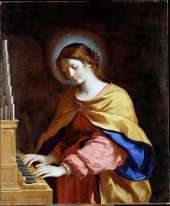 Today is St Cecilia’s Day. She was a Christian in the third century who welcomed others into her home where she led worship. This drew the attention of the Roman authorities, and she was martyred for her faith. Legend has it that she sang to God on her wedding day with such beauty and sincerity that her pagan husband became a Christian convert. She became the patron saint of music.
I would also like to remember today the legacy of Jeremy Plummer with gratitude for the lasting impact he made on the music in this church.
The urge to sing is deep in the human psyche. Human beings were singing tens of thousands of years ago, probably before they used words. It’s not surprising that the Bible is full of references to singing. The book of Job tells us that “the morning stars sang together and all the heavenly beings shouted for joy” at the creation of the world, and the book of Revelation that at the end of time “every creature in heaven and on earth and under the earth and in the sea, and all that is in them” will sing to the Lamb on the throne. Heaven will be full of song.
Throughout the Bible the reaction to marvellous events has been to burst into song, from Miriam’s song after the crossing of the red sea to Mary’s song when she learnt she would be the mother of our saviour. As well as those spontaneous outpourings we know the Psalms which were used in temple worship, that Jesus and his disciples sang hymns (although frustratingly we don’t know what) and that the early church sang – as Paul puts it “with gratitude in your hearts sing psalms, hymns, and spiritual songs to God”.
St Augustine wrote, “He who prays sings twice”. That’s once because of the music and once the words. St Paul writes “Likewise the Spirit helps us in our weakness, for we do not know how to pray as we ought, but that very Spirit intercedes with groanings too deep for words”. Music enables us to express those deep longings emotions that we cannot find the words to express. Sadness, longing, love and joy can all be expressed and evoked through music itself. Not all vocal music has words – indeed Karl Jenkins wrote the song Adiemus in which the words, though evocative, have no meaning in any language. But if we sing hymns where the words and music complement each other, the effect is powerful. Praise my soul the King of Heaven and My song is Love and Unknown affect me every time. It is easier to memorise words set to music, and some hymns, like the ones by Charles Wesley, are filled with theology we can muse over later. Have you ever thought about the words of Hark the Herald Angels Sing? They are packed teaching about Christ and the reason for his birth.
Both the hymns I mentioned I sang at school, and that brings us to another aspect of music. Very often, when people are lost in dementia or in a coma, music can get through to them even when words have no impact. Sometimes people who cannot remember what they had for lunch can sing whole hymns word perfect. Music evokes memories and many of us have songs from childhood we still love, even though we know the words are trite or the theology dubious. In times of doubt or weakness hymns we sang on our wedding day, at our confirmation, or on another day when it just happened that we felt close to God can recreate in us the feelings of hope and safety we felt at the time.
When we sing in church our audience is God, not each other. When we listen to a beautiful anthem, we are overhearing the choir’s offering to God, when we sing ourselves, we do it to the best of our ability, but the Lord requires a joyful noise, not a polished performance. Everyone should feel able to join in.
And lastly, singing can be a form of mission. When people hear a congregation singing as though they mean it, it has an impact. People too shy to talk about their faith will happily sing about it, and their sincerity will be evident in the way they look and the way they sing. Others will wish to share that hope and that joy.
I am aware of the irony of preaching this sermon in a said service, and silence and quietness also have a place. Most of you, I am sure, will be singing over the Christmas season, even if you don’t regularly come on a Sunday. When you do, join the angels in giving thanks to God, for the birth of his son, and also thank him for the gift of music.
 St Margaret's Church Prestwich