
This article was written for the December 2025 issue of our parish magazine. Here it is for you again:
Our parish has quite a reputation locally for the quality of music in worship. Imagine my surprise when I heard our choir described recently (by a regular and longstanding parishioner) as not a “proper” choir. I asked for clarification. Apparently, that bold statement was made because
- The choir does not wear robes, and
- The singers are “very shy” and won’t sit up at the front.
This got me thinking, and I did some digging. Here are my research queries, and what I discovered.
What is the purpose of a church choir?
ChurchLeadership.com (https://www.churchleadership.com/leading-ideas/four-functions-church-choir/) tells us that there are three main purposes of a church choir:
- To lead and enliven the congregation’s song
- To sing beautiful and challenging music that the congregation cannot, enhancing worship and praising God
- To serve as a small group within the church for faith formation
Taking these in turn, our choir knows the hymns that are to be sung each week. They are practiced at the preceding weekly rehearsal, and sometimes ahead of the service, in order to lead the congregation and help them learn new hymns. With a small congregation that sits scattered about the rear of the nave, it is helpful to have a group of confident singers leading the hymns to prevent congregational singers feeling isolated, and as if they are the only one singing.
Most weeks we sing an anthem that is appropriate to the liturgical season. Usually this is whilst communion is distributed, but the traditional time is straight after the sermon. The congregation would then hear the Word (in the bible readings), have the Word explained (in the sermon), and hear it applied (in the anthem). We sing a rich and diverse variety of music from all around the world, from each of the past five centuries, and sometimes we even sing music that has been written by women! We usually sing in at least 2-part harmony, sometimes 3-part harmony, and dedicate the bulk of our rehearsal time to doing this well. Our repertoire includes music by (in no particular order) Duruflé, Britten, Quartel, Jenkins, Boyce, Redman, Purcell, Rutter, Humperdinck, Handel, Cohen and Mozart.
Our choir members attend church each week first and foremost to express their faith and to worship God. Note that singing hymns and anthems during church services is an act of worship, and not any kind of performance. Learning and practising hymns and anthems for several weeks ahead of time creates a bond between us that runs deep. We care for and support each other in our musical and spiritual development – and we have fun together along the way.
What is the minimum number of singers for a church choir?
This depends on many variables, but the general agreement from the choral community is at least two voices per part. As we have 2 x Soprano I, 4 x Soprano II and 3 x alto, plus Tom and I, we meet numeric criteria for an upper voice choir.
Does a church choir have to wear robes?
The Guild of Church Musicians (https://gcm.org.uk/everything-else-an-organist-should-know/2-running-a-choir/#ch10.1) tells us that there is nothing in canon law covering the robes a choir may or may not wear. However, there is a lot of custom and practice around this issue. Reasons for wearing robes:
- Uniformity – all choir members are equal before God, regardless of social demographics
- Professionalism – robes can instil a sense of purpose and seriousness in a choir’s ministry
- Symbolism – in some churches, robes are worn to visually connect the choir to ministerial attire worn by clergy
Reasons for not wearing robes:
- Comfort and practicality – robes can be very hot and cumbersome; they also present a trip hazard when walking up and down steps, and when kneeling to receive communion and rising again afterwards
- Modernisation – absence of choir robes gives a more contemporary and accessible feel to the music, better reflecting the diversity of the congregation
- Cultural fit – in some churches, robes are considered too formal or ‘stuffy’
Our choir chooses, for practical and musical reasons, not to wear robes, and this decision does not impact on our ability to sing in any way.
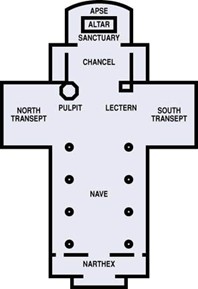
Where in church should the choir sit?
Again, there is nothing in canon law about this. The “right” place for a church choir depends on theology, architecture, acoustics, and tradition. There are several common placements, each with its own purpose, pros and cons. There are given here, along with implications for St Margaret’s:
1.The Chancel (front of the church, facing the congregation – we don’t have space for this at St Margaret’s)
| Why choirs sit here: They can easily lead the congregation in singing Direct communication with the clergy and organist (but our organist sits to the side and is impossible to see from the chancel) Common in Protestant churches | |
| Pros: Clear leadership in worship Strong visual presence | Cons: Can feel like a performance if not thoughtfully arranged Blocks the congregation’s view of the altar |
- Choir Loft or Rear Balcony (over the narthex – a superb place to sing from, but we have neither narthex nor balcony at St Margaret’s)
| Why choirs sit here: Historically common when organs are at the back Sound projects well over the congregation Allows worshippers to focus on worship rather than the choir | |
| Pros: Excellent acousticsLess distracting visually | Cons: Harder for the choir to feel connected to the liturgy Limited space in some buildings |
- Choir Stalls facing each other in the chancel (previously favoured in St Margeret’s, and traditional in Anglican, Catholic, Orthodox and monastic settings)
| Why choirs sit here: This antiphonal arrangement supports call-and-response singing – which we rarely useIt mirrors ancient worship practices – but it’s 2025! | |
| Pros: Ideal for liturgical chant – which we do not do Symbolises the choir as part of the worship leadership, not performers | Cons: Choir is behind the altar and feels excluded from worship In St Margaret’s, singing in the chancel cannot be heard by the congregation Due to St Margaret’s architecture and acoustics, singers in the chancel sing at least one beat behind the organ and congregation – so it’s just as well they cannot be heard! |
- Front Side Seating (currently favoured at St Margaret’s)
| Why choirs sit here: Easy access for movement during worshipDirect connection with organist/pianist | |
| Pros: Choir can see the altar and take part in worship Choir can be heard by the congregation | Cons: Can’t think of any |
By any of these metrics, Maggie’s Music Makers is indeed a “proper” choir, that welcomes new members. If you love singing and want all the health and wellbeing benefits that come from regular choral singing, please come and join us. There is no audition process and no expectation that you are able to read music. For more information click here https://stmargaretsprestwich.com/music-at-st-margarets/, or speak to any member of the group.
Carol P
Director of Music
 St Margaret's Church Prestwich